Tuesday, 2 September 2014

A feel good moment (or two)

Today, Period 1, was the first time seeing my Year 10s this week. I had decided to create a Google Doc for each student, and inserted a table that went through questions I would ask them during our 1-1 conferencing (previously I had just recorded very brief notes in my mark book). I told them what I had done, and that it wasn't 'secret' and would show them what I had typed at the end of our chat. My plan is to write in the table as we go, and then the next time we have a 1-1 I will add another table at the top of the page, and so on. This was we can have a running record. I am considering sharing the document with the student, with viewing rights, so that this is transparent.

At first, students kept asking, "Miss, can I please go not today?" I reminded them that this wasn't a you'll-get-in-trouble-for-doing-not-much-work talk, but a talk so I could see where they were up to, how they were finding it, and how I might be able to help them more.

After I had explained that, one of my girls - in fact it was Student B - started just talked about a problem she was having (not related to school). I asked her to come and sit next to me, so that we weren't talking across the class, and then said, "How about you go first then, for our conferencing?", to which she agreed. I then added rows at the bottom of the table for 'What else is going on", which was sparked from why she had initially come to talk to me.

During my 1-1 with Student B, she reminded me that it is planned, at the moment, that she leaves at the end of this term for boarding school with her sister. When she mentioned this, I suggested to her that we come up with goals that she wants to achieve by the end of this term - she was very keen on this, so I added this row, too, to the bottom of the table. Unlike last week, where Student B was complaining about the work and the level of the book (that it was too hard and boring), today she identified in our 1-1 that "I just need to get on with my work" and "stop distracting others", and that the book was at the right level for her. My first feel good moment came when I asked her what else I could do to help her, to which she replied, "You're already helping, Miss!" Here is a record of our conversation (note: the 'What else is going on' row has nothing in it, as that is more personal to the student)...

Student B - Tuesday 2 September, P1.
What page are you up to in your written text?
Eg and Me. Pg 54.
Where are you up to in the work for your written text?
Up to coming up with q and a for Chapter 7.
How is your Reading Log going?
No. Focus: to fill in your reading log.
What books or films have you been doing for Reading Bingo?
Whale Rider - film.
How are you finding the unit so far?
Challenges?
Interesting?
Book is weird. Cause don’t know the character’s name.
Right level of book.
Challenge - not putting enough time aside for it.
Interesting - speech - likes doing speeches.
What could happen/what could I do to help you improve your chances of success in this unit?
In response to “What can I do to help you more?” - reply: “You’re already helping, Miss!”
Self - stop being a distraction to others
What might you like to see added or taken out?
Blog activity for Reading Bingo - “because I don’t know how to do that type of thing.”
Additional notes/questions
“I just need to get on with my work.”
What else is going on?

Set goals
1. Finish Eg and Me.
2. Activities for Eg and Me
3. 10 books and 2 films for Reading Bingo.
4. Some of the Reading Bingo Activities.


The next student who actually had volunteered before Student B was Student E. (It just happened that both students I conferenced with today were focus students.) She had volunteered after exclaiming, loudly to the class, that she had to get on with her work, and that she is always too busy with sport outside of class to do classwork. When I spoke with Student B, this is where my real 'feel good' moment came from. We started talking about 'What else is going on' as this is initially what she wanted to talk about, which is great. No need to go in any particular order. She spoke about how she has sport most nights, and on days when she doesn't have sport she has to look after her baby sisters - plural. So we chatted about her family - it turns out she has 3 younger sisters (12, 11, 3, and 7 months) and 4 older sisters (21, 19 year-old twins, and 16). That's a total of 9 of them! That's a lot 'else' going on.

Moving on to talking about the book, she was able to talk to me about the difficulties she was having. She was finding that she would read, and then forget what she had read. This meant that she was taking ages, as she kept going back and re-reading a lot. We talked about why this might be, and possible things to try. We went through some of the other 'text' based questions, and then after talking through what she had to do for the speech, we got on to what she wanted to do when she left. Student E was very certain that she wanted to be a kindie/primary teacher, but then looked around and started laughing. When her attention finally focused again, we got into how this could be possible, and what could we do to help her get there. On this, she started to well up, so we went and sat outside (where I could still see the others through the ranch slider). When we got down to it, she was open and told me that she didn't believe that she could do it; she could see others in the class doing anything, but she didn't believe in herself. We ended up having a long chat, which ended up with her being over the moon when I offered to mentor her for school. (We have a mentoring system, mainly for borderline seniors and all Year 13s already at school.) Going back inside, we sat down and come up with one mini-goal for her to achieve - reading 2 chapters each night on average (about 20 pages), to be finished when we chat again next Friday.

Here is a record of our 1-1 (note: some things have been deleted).

Student E - Tuesday 2 September, P1.
What page are you up to in your written text?
Hatchet - pg 38
Where are you up to in the work for your written text?
Chapter 5. Wants to read through the book and then come back and answer the questions.
How is your Reading Log going?
No.
What books or films have you been doing for Reading Bingo?
Question about Speech - what do I need to do? Note: now explained and [student E] understands.
How are you finding the unit so far?
Challenges?
Interesting?
Find it hard to read - “I always forget what I read”; “no matter how many times I read it I always forget.” Always been like that. Told to “Keep persevering!”
What could happen/what could I do to help you improve your chances of success in this unit?
Set mini goals to achieve
What might you like to see added or taken out?
-
Additional notes/questions
Going to mentor [Student E]. Set mini goals.
What else is going on?
Sports - basketball, and netball
Touch now - every day
Look after baby sisters - 2 - 4 younger sisters total: 12, 11, 3, 7 months. 4 older sisters: 21, 19 twins, 16.
Teacher. Kindie and Primary. 
Loves PE and Performance. Didn’t like reading, or read, at all until she read “The Fault in our Stars” by John Greene. Also has now read “The Maze Runner”. Read Greene’s book in like a week!
Goals
1. Start book again and read right through. 154 pages. Aim for 2 chapters per night. 10 days aim to have finished. Check in Friday 12th September.

Overall, I really felt like I connected with both students today, in terms of their English work and as a person. They BOTH came to me at the end of the lesson and said, "Miss, you're really great to talk to. Thank you." I went away from today's lesson with that warm feeling inside. I got what I needed to, checking on how they are going, and made a positive connection. And then they worked!! No complaining like I have been getting. I am going to be optimistic and believe that this was the turning point for these two girls.

Sunday, 31 August 2014

Slowing down... but not really

Sometimes teaching can feel a little overwhelming. There just seems to be an endless 'to-do' list.

The week just gone I (not in any order, chronological or otherwise): finished marking 4 sets of senior exams; planned Creative Writing 'Workshops' for my senior students; wrote 4 class sets of senior reports in 12 hours (was finished by 11:58 Thursday night); commented on my Year 11 Creative Writing Piece 2; marked my Year 13 Close Viewing Internal; ran a department meeting modelling Unit Planning; had an HOD meeting in preparation for ERO; supported the Football Girls, 1st IV boys, and the Hockey Girls on Wednesday night; found one Year 13 had plagiarised an assessment; commented further on some Year 13 Writing Portfolio work that is in the process of re-crafting; helped a fellow teacher with getting and then organising her responses from a Google Form; had a meeting for the BeLT on Thursday afternoon (till 5); and had two students sit exams, and supervised them, as they were absent during the actual practice exam. I am pretty sure I have left things off; these were just all still in my mind. I, of course, also taught my 5 classes. With all this going on, I didn't leave before 5 any day, and some days not leaving till 6. With a 40 minute drive home, that makes for some long days. Once home, I usually work for a few more hours.

Work-life balance is not something I can manage at the moment. It is probably more like work-work balance. I realise that a lot of this is my choice, but I don't do things in half measures. Probably why many teachers leave the profession.

However, as I received my Post Graduate Diploma in Education in the mail this week (which I passed with distinction mind you) my husband and I drove to see my folks on Saturday, as they wanted to take us out for dinner to celebrate my award. We came home today, stopping to look at possible areas to rent in the future. So, I took some time out. Unfortunately, it just meant that not everything I needed to mark today got done (and that I am blogging at 9:30 on a Sunday night).

I would think things might slow down, but they aren't really. We have parent-teacher interviews the week after this one coming, and I am helping with the Power Up initiative for Pacifika students a few times, which runs on Monday nights from 6 - 8. The Year 11 Creative Writing, as well as my Year 12 and 13 Writing Portfolios, is coming to an end very soon, and Personal Reading Responses keep coming in.

So, we will see. Fingers crossed this week will at least be a bit quieter.

A little disheartened

This week presented me with a few moments where I just wondered why. I felt like I have put a lot of effort into putting together a unit for my Year 10s - my inquiry - and it seems to be slightly falling apart.

I see my Year 10s three times a week (not many at all!).

On Tuesday, Student D sat there, not engaging at all in his novel. He then claimed that "this is boring", and continued to not read. He hadn't read much either, in total, and had only done a bit of the work on the chapters. I thought to myself, "Okay, that's okay. I can handle this" and then proceeded to offer him the short stories that had been on offer in the first place. He chose the Evan Hunter short stories, as they were about 'gangs' and that grabbed his interest. I asked him to keep reading his novel for that lesson, as I had to get the short stories and resources organised for him.

The same lesson presented Student B claim that she "hated her book" and "why did you have to choose such boring books?" Ahhhh. I keep trying to remind them that they selected these out of the choices that were on offer, and that a usual class would all be studying the same novel and not yet a choice. I asked her to keep persisting, as she was a reasonable way through the novel, and had also done a reasonable amount of the comprehension work on what she had read.

Not a focus student, but that lesson also had a student be 'blue slipped', as she did not want to engage in the work and was being quite defiant. Student A and E were also absent (Student A has been away quite a bit, in fact - must check up on attendance statistics there).

The next time I saw them was Thursday. This lesson Student D attempted to wag my lesson, but was brought back and was not interested in completing any work. Student A and E were still away.

Friday I see this class Period 5 (after lunch and the last lesson of the day). Boy, what a challenge. Student C was away. I gave Student D the short stories, to which he was grateful, but then didn't really start reading them (he is more interested in his 'new' girlfriend, who is also in the class). Student A and E returned.

Student A was so distracted and when I suggested that perhaps he needed to take the book and work home, so that he could catch up (and they were told right from the get-go that they would need to complete some work at home) he completely, flat-out refused, claiming that he was busy every night and that his parents would not make him do it! Extremely frustrating. He went on to read 1 page in 45 minutes - not progress that is incredibly encouraging. He has read a total of 7 pages thus far. This is a novel that was initially put out for intermediate aged students.

Student B continued the protest of 'hating' what she was reading, and was being silly and mucking around. She kept trying to avoid doing the work on the novel, and was very argumentative.

Another boy, again not a focus student, continued refusing to work or follow simple instructions, so ended up being 'blue slipped' - I checked up once class had finished, as he told me as he left that he wasn't going to the office. And, indeed he didn't.

Student E worked well, mostly.

It seems about half the class is really flourishing and enjoying what they are doing, and the other half are still just as unmotivated as before. What to do? What to do? I have tried a lot of things to engage this class, and not much seems to be working. Let's hope for a better week this week.

Sunday, 24 August 2014

Where to begin... It's been a while

There are quite a few things that have happened over the last week and a half - while that's technically not a long time, it feels like a LONG time since I last blogged. I'll try an sum up a couple of things, otherwise this could get rather lengthly.

#1. School visits for the BeLT

So - Week 4, Thursday and Friday. The BeLT (Blended e-learning Lead Team), of which I am a part of, went on two school visits - Thursday to Rangitiki College in Marton, and Friday to Otaki College in Otaki. The purpose of our visits was to see how they were integrated DIT, specifically Chromebooks. into their teaching and learning. We, as a school, are looking at getting Chromebooks, and the BeLT members each have one that we are 'trialling' at the moment.

Rangitiki College - this is a rather small school, even smaller than ours (and I thought ours was small). They are using Chromebooks in their lessons, and have a few COWS worth that teachers can 'book' out. These are used a LOT more than the actual computer labs. Students can also bring their own devices, and the school has lined up a deal for the students to be able to purchase Chromebooks. Some students, however, had their own device that was not a Chromebook, and that worked okay as well. Students are just used to using Google Drive for their work - in fact, the students we saw were using Google Drive for all of their subjects, and it was almost like second nature. The Health class, a junior class, that we saw was using Google Presentation to document their learning over the term, and a senior English class was using Google Docs to record notes of their close viewing of a scene from the film they were studying - which they were all watching over YouTube. Students in this class were then able to share notes on their scene with others in the class. Rangitiki, however, are having a few network issues - connectivity issues.

Otaki College - there are several classes of Year 7s and 8s who are using Chromebooks as a part of their class - digital classes, and I believe a Year 9. However, next year all Year 7s, 8s, 9s, and 10s will be using Chromebooks. This school has funding, which has enabled parents to put a 'down payment' on for purchasing their child a Chromebook, which they then 'rent to own' paying a certain (small) amount each week. The school has a Kawa of Care, and students are not allowed to take the Chromebooks home until the parents have come into the school and had a 'lesson', which also goes over the Kawa of Care. The students who showed us around showed us through how they have used Chromebooks as part of their learning, including how they go to their class 'Google Site' at the beginning of each day - the teacher has everything planned out, and the students look on the site to find out what they are doing for the day, and when they have certain individual activities on. This was FAB! Teacher planning, student engagement - students were even able to 'log in' from home, and some even completed the work from home so that they didn't feel like they were being left out. It was so great to see how DIT were just a part of their every day school day.

Both schools use Teacher Dashboard - something I have seen in action a couple of times. I believe this is quite a valuable tool, and definitely worth investigating.

#2. Technical issues continue

On another, but related note, my Chromebook is still NOT working at school. For some reason it is not letting me connect or log into the school wireless, but works perfectly fine at home. I tried 'powerwashing' it - making it start from scratch - to no avail. We are also still not having any luck with our school 'gmail' accounts - we cannot use it with anything Google, like Blogger, Google Plus, logging in to Google Docs (or anything else) on things like a IPad - the Gmail app for IPads doesn't even recognise our school email. We do have access to our school Google Drive, when accessed through our school email. However, having two Gmails - a school and a personal one - to do different things, but all for school, is becoming incredibly frustrating. Surely it should just be something quick and easy, but we are having a lot of trouble getting this sorted! This also means that we cannot log into our Chromebooks with our school account - definitely something we need to get sorted before we even think about the students getting them.

Sarah and I did, however, get into Google Classroom last week, and the BeLT team did FINALLY find out that we already have a GAFE account - it only took us stumbling onto this information through trying things, not from our help people.

#3. Update on my MLE

As I mentioned in a previous post, my DP who went away to conference with me and I had come up with a plan on how we might be able to turn my classroom (which used to be the old common room) into a MLE. Well, this got underway on Monday of Week 5 (the week just gone by). I only remembered part way through that I wanted to document the process, and had forgotten to take any pics. However, the week before I had taken some pics of my Year 11s completely engaged in their study (taken with their permission), so here are those, plus some of the room part way through its half-way transformation.

As you might be able to see, there is space at the back here with a big circle table on its side - this is the old kitchen. There is also a room behind that door - a room we cannot get into at the moment (it is bolted from the wrong side, and filled with lots of old desks and things. The pictures are taken from the front of the room, where the teacher desk is, and the whiteboard and projector + screen. The desks are set up in groups, as that is usually how I try to work.

And here are some pictures of how we have transformed the room, so far. It is mid-way through - some more changes are to come.

The transformation in progress:


 The mid-way product (still a WIP):


#4. Best Practice Workshop

On Thursday of Week 5, one of my staff and I went to the English Best Practice Workshop. It focused on the Level 2 Writing Portfolio and the Level 2 and 3 Create a Visual Text standards.

It clarified a few things around the writing - particularly around 'developing and sustaining' of ideas, around 'errors', and around the types of writing tasks that do not seem to work so well.

The Create a Visual Text standard information helped a bit more than the writing. It helped clear up some questions I had around the use of images from Google. Also, it highlighted that my definition of 'manipulation' of images is not the same as what is presented, particularly in the Level 3 exemplars. The addition of symbols, the repetition of them, and making them change is important. Webpages are not encouraged at either level, as they seem to focus more on the verbal than the visual.

#5. Teacher Only Day

The BeLT worked hard to put together a Teacher Only Day for our school. On Friday, just gone, we organised workshops that covered a range of things, in directions for where we want to go. This included: Blogging for beginners, Starting a Twitter Account, Google Drive for Beginners, Google Docs Intermediate, Using Doctopus, Using Goobric, Different ideas for submitting assessments, Using Pinterest, Using Google Forms, QR codes - and how to create them, the Google Basics courses and exams, Google Apps, and using and organising your Gmail and Google Calendar. Workshops ran for an hour, and teachers went to 4 workshops. Each member of the BeLT ran a workshop in each session, with the help of the Principal's Assistant. It took a lot of organising, and a lot of work went into it. At then end of the day, teachers had one hour to put together a Google Presentation on what they had learned in each of their 4 sessions.

There were, like there always are, some who were not so 'enthusiastic' about the day, and went through the sessions only because they had to, not because they wanted to. However, most people were very thankful, and those quiet 'thank yous' made all the difference.

The magnificent Sarah, who makes cupcakes 'on the side', made cupcakes for her workshop on QR codes - with an edible QR code on top!! Participants had to scan the QR code as part of the workshop - genius!


My role:
I helped put together the initial ideas for the workshops and organise the sheets for teachers to sign up on. Ant, Guy and I spent two hours trying to sort out individual teacher timetables for the day, before we decided that a Google Form would be better, and put 5 options for each session.

I also ran the following workshops: Google Forms, Google Docs Intermediate, Doctopus, and Goobric. They all went well, and my participants seemed to take a lot away.

I created a short video that we showed at the beginning of the day, which stepped teachers through how to create a Google Presentation - this was my first ever video, which is now on YouTube!! I used QuickTime player on my laptop, and recorded what I was doing while narrating over the top. I felt like a dork, but it seemed to go down well.

#6. Reflection

After a busy few weeks, I still don't feel like I have time to breathe. I am yet to finish marking my exams, although I am ALMOST there! We have reports due at the end of the coming week. I have a Year 13 Internal (the Close Viewing write up) coming in by 11:59pm tomorrow night (the advantages of Google Docs) - although I have only had two Docs shared with me thus far - starting to get a bit worried. I was supposed to have Level 1 and 2 Personal Reading Responses in for their first checkpoint on Friday (mostly via Google Docs) - this is an optional additional, extra credit assessment that most of my students opted in for. However, I have only had 3 in, in total :-(. Gotta check that out tomorrow, and might need to make some phone calls to parents. I have an HOD meeting tomorrow afternoon, Department (catch up) meeting Tuesday afternoon, students coming to study group on Wednesday afternoon - and then we are nearing the end of the week already! Far out!

I am also looking into learning how to code! I really want to investigate ways that I can then bring in coding - learning to, creating games and/or apps - into my English programme. There may not be a way, but I think it would so cool if students were able to learn those things. Maybe an English programme is not the right place - but I'm gonna figure it out! :-) Maybe I just need to re-train as an DIT teacher?... Maybe I'm in the wrong industry (probably not though)?... Food for thought.

Wednesday, 13 August 2014

Running out of steam

Today I finished marking my Level 2 exams, and have started on my first set of Level 3 exams.

I was actually quite impressed with a lot of my Level 2s. While I didn't have amazing results, there were a lot of 'achieveds', which is a significant improvement for some of them. There are students in the class who are really listening and following advice and guidance that has been given in their learning logs. They are really trying everything to improve what they are writing. Also, most of them attempted the Unfamiliar Section, which they were not so sure about. A great step forward.

However, I feel like I'm sometimes talking to myself with some of my Level 3s. And the thing is, it is not that they don't know the film, or how to write essays - most of the ones I have looked at are reasonably soundly structured. I am only a few in, but they are a) not writing a full 4 body paragraph (minimum) essay, and b) are only focusing on the beginning of the film?!?! I remember clearly going over with them, just the other day, about showing their knowledge of the whole film! This is going to need to be something that I focus on working through with them when we come back. I need to figure out a different way of going over it with them, and more practise I think. I have to admit that for a lot of them they have made leaps and bounds improvements - not having written a literary essay in many years, and are now writing as well as they are. We just need to work on fine tuning it now (and remembering that we are arguing a point, not just writing about the film).

I have to finish this set of Level 3s, have another Level 3 class, plus my Year 11 ones came in today. These Level 3 ones are taking me at least 1/2 hour each, with the comments that I am writing. I need to speed up, probably write less (although this is their formative attempt, and they will use this to help them improve for the end of year exams), and plough through.

I am looking forward to the visit with our BeLT team to Rangitiki College/High School tomorrow, and Otaki on Friday, to see how they are using Chrome books.

Oh well... back to it.


Tuesday, 12 August 2014

Just saying...

Not much today - been busy with exams (and creating my lego 'man' - 'Super Geek Girl'). Helped out one of my PRTs in marking the Unfamiliar of the Level 2 exam (first time marker) - we just marked in the same room, talking through answers we were unsure of. I even managed to mark my whole set of Level 2's Unfamiliar. With three class sets of exams today, and one more tomorrow, plus 3 pieces of writing for senior Writing Portfolios and Level 3 Connections to mark, I need to get speedy - more so than I am.

HOWEVER, today a had a freaken AWESOME lesson with my Year 10 Inquiry class!! They were all engaged - reading or doing activities. I was actually really proud of them when my DP came in and they were all quietly engaged in their work. Even Student D, on of my reluctant male readers, was working on answering questions on the chapter he had read - and he had only been back in class 1 lesson. It was fabulous - just saying :-)

Monday, 11 August 2014

The process of processing: A self-reflective 'debrief' after 3 days in the big smoke

My last two posts were more informative than reflective, and I think there were too many ideas still flying around my head to make any sense of anything. So after a day back at school, and time to process, I thought I would reflect on my three days away.

I had been to ASHS a few times before, but never when there were students there (strange I know). It was a completely different experience visiting when the students were there, and when there was all the staff. I found so many of the things/initiatives that are happening at ASHS so inspiring. Everything they do at their school is to improve teaching and learning, and the learner is always at the centre. I really like their Impact Projects, and how they are promoting learning for learning's sake through the projects (although some have the possibility of credit earning as well; it is just not the main focus). I think their 100min periods are a good idea, as is the dedicated time to tutor groups and how these are organised. I can see this working really well to foster relationships - which are the heart of what we do (or at least should be). I REALLY like how everyone is 'mentored' - the tutor teachers know their 15 students extremely swell and guide them, team leaders guide the teachers working in their learning space and HODs (or Subject Specialist Leaders) guide those within their departments, and HODs and team leaders are guided by the DPs, who regularly meet with who they are guiding, and the principal guides the DPs. There is support the whole way through. Their teacher inquiry, which is compulsory, is high-stakes. High expectations are set, and they must be met. Monday afternoons are used to alternatively work one week within their teams and one within their departments on their inquiry. There are several times throughout the year when they present to the staff, on a Tuesday morning I believe, on their progress. At the end of the cycle, they must put together a professional presentation and deliver this to their learning space team. Then 8 'finalists' are presented to the staff, and a big deal is made out of them. This is recognising teacher achievement, and encourages people to take their inquiries seriously - I mean it is all about helping make our teaching and learning better after all!!

-------------------------

Now the #edchatNZ conference! If I had to sum it up in one word: AMAZEBALLS. I got so much out of the two days of this conference. It inspired me! It gave me direction and new ideas, allowed me to network with other like-minded teachers (as well as other English teachers), and it made me realise that I am not alone. I am believe myself to be a future focused teacher, and I would do anything to help improve my teaching to help the students improve their learning and engagement (and to help make their time at school more positive). I completely believe that what we do should be centred around our learners. I am always trying to learn new ways of doing what I do, and am willing to give things a go. And I was surrounded for two whole days with people who thought like me!

I thoroughly enjoyed all of the workshops I went to, and was able to take things away from each of them - I mean, come on. I ended up with 14 pages of notes that I had typed on my Google Doc over the two days. But there were a couple of stand-outs for me - the ones that have inspired my 5 page 2015 'brain-spew' plan of what direction I want to head in.

-------------------------

1) Linda Rubens (@lindarubens) workshop on flipping the classroom (and a contact I have now made with another teacher teaching the Create a Visual and Verbal text at Level 2 and 3!). This is something that I have been interested in, and kind of knew what to do, but she introduced a nice and easy way to flip the classroom using the IPad App - 'Explain Everything'. I had downloaded it before the session had even ended. I can completely see how this could work with my classes, and I cannot wait to give it a go. Students will be able to come back to the recordings/YouTube clips time and time again, when they need me 'there' to help guide them through. I liked how Linda also talked about how students were also able to have the clip playing, through earphones, during the lessons where they were completing the corresponding task/activity/assessment. It also means that they are learning the 'nuts and bolts' via your video, and you can spend the time in class talking through, and having discussions around, the context.

-------------------------

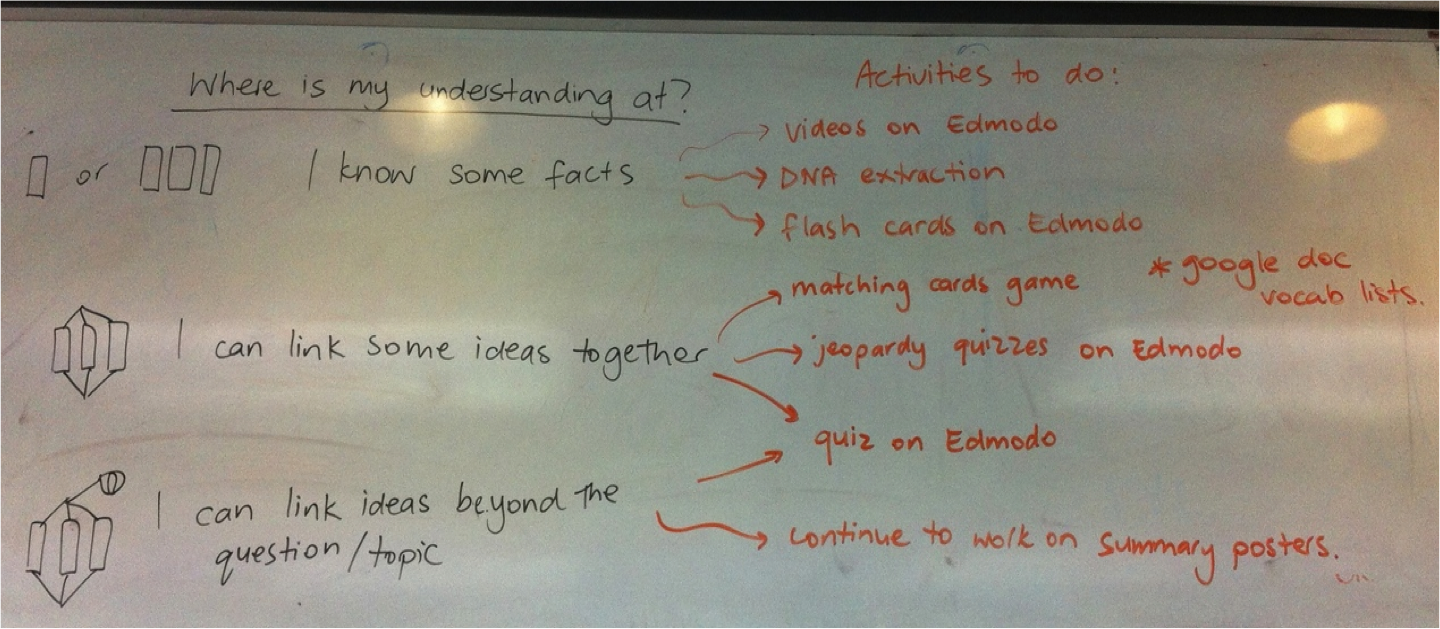
2) Andrea Hensen's (@AndreaHensen_nz) session on using SOLO in the secondary classroom - I learnt a LOT about SOLO during this session. In fact, in evaluating where I was at (in terms of my understanding of SOLO and how it could be used) at the beginning of the session, which Andrea got us to do using the SOLO hand signals, I guessed I was at about the Uni-structural level. I can see clearly how this could be used in the classroom, and I really liked the usable rubrics. The suggestion that for some tasks you could co-construct the rubric with the students was great - it helps students with their understanding of what they need to do, and helps them take ownership of their learning. And we all know co-construction is the way to go. Of course this would not be feasible for all tasks and activities, but definitely for some. I also learnt later on on Day 2 that there is a rubric generator on Pam Hook's website - HookED. This was something practical, again, that I could take away and see myself using and implementing in my classes.

-------------------------

Now, the next two are my majors! These are the ones that aligned completely with what I think, and gave me the focus and direction to plan where I want to go next.

3) The PBL session, run by Sarah Wakeford (@hpssprojects). While I wouldn't be able to run Big Projects the way they do at HPSS, what I was able to take away from this workshop I could see being easily adapted into my future direction. I LOVE the idea of Big Questions governing students work. I completely agree that PBL helps to make student learning MUCH more authentic and relevant to the students. While, in moving forward in the near future, I may not necessarily move straight out into the 'authentic partner in the community' bit, I am already formulating ideas, and have talked them over with my 2IC. I want to allow my students, especially the seniors, the opportunity to inquire and investigate a big question that they have; one that is of interest to them. Juniors will be more guided. I want their learning, and assessments in English, to flow naturally out of what they are inquiring into. Blogging is a great way for them to track what they are doing. And this approach to PBL ties in great with my other TOP, MAJOR workshop. (Note: I am planning on doing further research and investigation myself into PBL.) When Sarah mentioned the example, for Social Studies, of instead of having a unit that studies 'Nazi Germany' rather turning it into an inquiry of 'What can we do to make sure Nazi Germany never happens again?' I was off! I had ideas ticking over in my head faster than I could think!

-------------------------

4) Megan Peterson (@mrsmeganpete) and 'Harnessing the Beast' - this was my top take-away workshop. Everything that Megan went through just clicked and felt right with my way of thinking. It was almost like she was re-affirming what I have been thinking for a while, and then some! I have been doing bits and pieces of what she went over, but I can now see how I can move forward - and move my department forward with me. WE are the ones who are creating the Beast of NCEA. I think a lot of people use NCEA as their excuse not to try. Dangling learning as the carrot and not credits (as many of us, or our schools) do is where we need to go. Figuring out ways, within the boundaries that are set by your department/school, to allow student choice around assessment and how to assess when ready and not when the calendar says so is so critical.

This tied into my thoughts around PBL, and made up a large part of my conversation on the airplane home with my 2IC. How can we move our department forward in the best interests of our students? And I think we figured out a way. Watch this space on where we move to next year - think student guided choice around Achievement Standards, authentic assessments naturally flowing out of inquiries, and assessing when ready.

I really love the challenge that Megan set, of not putting marks on anything until the end of Term Three/beginning of Term Four. This is something that I have kinda tried to do, with the focus being more on the feedback and feedfoward, but I have still (reluctantly) put marks on (formative work towards externals, not the portfolio work for internals).

I was actually reflecting on this yesterday afternoon, as I was marking four class sets of practice essays for my seniors. Today was the last day before I see them, before their practice exams which start tomorrow. Now I hated, and I mean in my gut, putting grades on these essays. I could picture the students' faces, and their reactions, when they hadn't done as well as they had hoped (and particularly those who did not achieve). All I could think was that it was going to crush some of them, and right before exams no less. Now, I was almost tempted to put no grades on, but with no notice to the students I thought that would be unfair. HOWEVER, post-exams with the practice essays that they will be writing, I am going to endeavour to take this approach - no grades, let's just concentrate on the feedback and feedforward.

-------------------------

Now, I have also had some conversations with my DP who came to conference with me. She went to a session on MLEs, and how you don't need to bust down your walls to create an MLE. And then we started talking about how my classroom offers prime opportunity to create a MLE. We talked through use of the 'kitchen' space at the back (note, my classroom used to be the old student common room), about clearing out the room at the back of the class (which is filled with desks and chairs and bolted/hinged on the wrong side so that you can't open the door) and using it as a break-out space, about getting rid of some of the desks to create more room, using the high tables I have to create different levels for learning within the classroom, the possibility of getting a couch in, creating partitioned individual learning spaces, and painting to give it a more vibrant feel (than the grey blah that it currently is). Most of these things will not actually cost anything, and I am willing to come in over the next break to 'working-bee' my room - even if I'm all alone! :-) I can see such huge potential, as can she. It is going to be fantastic. We will be able to use it as a model, so others can see how an ordinary classroom can be transformed into an MLE. She came into my class at the start of lunch, and we confirmed some of the ideas we had - I can't wait!

In fact, I might try to post pictures of this idea as it progresses. I will take some before pictures tomorrow, and perhaps post them once I have more of an official word to move forward :-).

-------------------------

 So, onwards and upwards as they say. This is all about me becoming a better teacher for my students. Thank you #edchatNZ for allowing me this fabulous learning and developing opportunity. This was so invaluable.

Sunday, 10 August 2014

#edchatNZ Conference Day 2 - Part II

So, it is Sunday. #edchatNZ conference ended at 3pm yesterday afternoon. I arrived back in Palmerston at 8pm last night. After a plane ride that seemed to take mere minutes, not a hour, my brain could not switch off. Donna and I talked non-stop on the plane home about what we had learned over the course of the last three days, and about our plans and direction for the future. It took a while to switch off, only to wake again this morning with my last three days on my mind already.

Day #2 of conference was a lot more epic than the previous day - in fact, I ended up with 10 pages of notes on my Google Doc yesterday (as I was documenting on a Google Doc as I went - technology in action) in comparison to the 3 the day before.

Before I re-cap yesterday's learnings, I forgot to mention in the previous blog post that HPSS is a Moodle school - or as they have named it 'Hobsonline'. They find it incredibly useful for providing links and workshop forums for students (although as I learned in my final workshop on Day #2 Google Sites, if used effectively, could do the same).

Yesterday, I was fortunate to attend 4 great workshops and ended with the final Key Note speaker. Not all workshops were DT (digital technology focused), but all were looking at bringing education into the 21st century and helping us move the learner into the centre focus when designing curricula, programmes, and learning.

Workshop 1 was about Project-based learning (PBL) and was run by Sarah Wakeford (@hpssprojects). PBL is about making learning relevant for students, and using a 'Project' to guide their learning. 'Projects' begin by posing (or asking the students to pose) BIG questions, a hook to get interest.

PBL is about giving students a voice, and it puts student inquiry at the centre to make learning happen in meaningful ways, and the technology helps them connect to the wider world. As Sarah suggested, "the best learning happens when we keep it real."

HPSS is lucky, in the fact that they have a community developing around them. The local construction companies have been great, getting on board with PBL at HPSS. HPSS is able to go to the construction companies and ask how the students can help them. Students are able to opt into projects that interest them, and a core concept of PBL is that everyone finds a role that they can contribute through for the project.

The process that HPSS go through for their PBL is: hook, plan, action, and show time. They even have worksheets for the students to work through, to help guide them through this process. Students also use Google Sites to document their process, and every week they are required to add to their website.


As teachers attending this workshop, we were challenged to put statements next to the part of the process that we thought it belonged to. Interesting activity - and we all wanted to know if we were 'right' afterwards.


They use a SOLO rubric to 'mark' the Projects, but also get four different 'agencies' to comment for reports - the teacher, the construction company (or other outside agency that is involved in the Big Project), other students, and parents (on the Show Time night).

HPSS have periods dedicated to PBL, which is a luxury not everyone has. However, as Sarah suggested, there is no reason why, like other schools, there can't be a 'Project Week', or even looking at integrating it into curriculum subjects. An example she used was from Social Studies. Instead of studying 'Nazi Germany', why not pose the question 'What can we do to make sure Nazi Germany does not happen again?', and then their project is built around that.

They see PBL in the senior school, once they reach that stage, to be run more like the Impact Project at Albany senior.

With PBL, Sarah ended by outlining four things that must happen:
1) it has to make a difference
2) it has to be authentic - try to work with an authentic partner in the community
3) it has to have a whole lot of different opportunities for students to learn
4) it has to be big enough for everyone to get involved (a place for everyone)

The following are two good texts to look at, to learn more about PBL, and the website bie.com is extremely useful.


Andrea Hensen (@AndreaHensen_nz) ran the second workshop, on Personalising learning through using SOLO in Secondary school.

She outlined for us that using SOLO helps students take ownership of their learning, while also guiding them through their learning. Students can use it to ask themselves: 'What am I learning?', 'How am I going?' (both which self asses), and most importantly, 'What do I need to do next?'

SOLO has been integrated right throughout HPPS, and is used in every curriculum area, for every task/inquiry/project/unit.

SOLO essentially is looking at students' levels of thinking, and can quite nicely align with NCEA. For example, 'Discuss' automatically links to relational and extended abstract thinking, 'Explain' links to relational, and 'Jusitfy' links to extended abstract. Going through this with students can help them with NCEa, and in how they answer questions/assessments, particularly in exams.

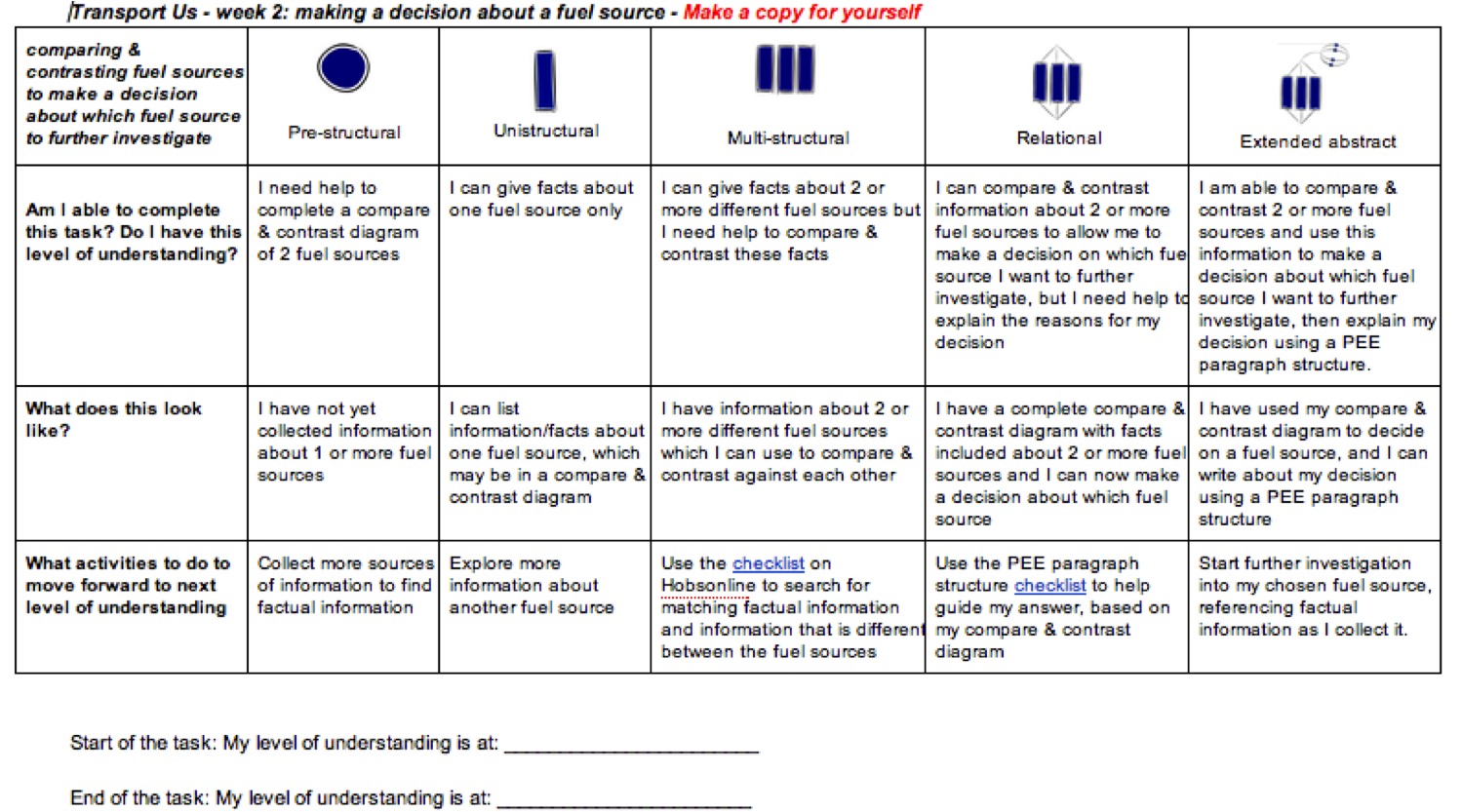
Once students have self-assesses using SOLO, teachers can guide them into what activities they should be completing.


personlising learning through SOLO.png

The following is an example SOLO rubric, created for a Venn Diagram task.


SOLO 2.png

Pam Hook is the guru for SOLO taxonomy, and some valuable information and resources can be found on the HookED website: http://pamhook.com/solo-taxonomy/ 

'Harnessing the Beast' was Workshop 3, run by Megan Peterson (@mrsmeganpete), and was an eye-opening workshop about using NCEA and how we should, or could, be personalising learning.

With NCEA exams moving towards an 'On Demand - anywhere, anytime' model within the next ten years, where exams will be able to be completed when a student is ready, via a computer, there is an increasing need to look at assessing students internally when they are ready.

Megan has worked in various roles, including HOD, contract work for NZQA, as a Principal's Nominee, and is now (as well as being a teacher) a moderator for NZQA.

Megan started her workshop by challenging us; she challenged our thinking. When she was referring to NCEA as a 'beast', she said that it is a "beast that we have created. And by we, I mean teachers." We often hear, "I really want to do things differently, but I can't because of NCEA." The "I can't because of NCEA" has become one of our greatest excuses. It is our perceptions, and perhaps lack of understanding, that had lead to what NCEA is in schools, or most schools, now. The fact is that NCEA and our curriculum actually allow for GREAT personalisation of learning for our students. Megan is actually having her Master's research being published in 'Assessment Matters' in a few weeks, which looks at NCEA and assessment - something to look out for.

She then dispelled a great myth of NCEA: it actually has few rules. Of course, it has rules around further assessment opportunities and resubmissions, and around authenticity, but what commonly happens in schools is we make extra 'rules'. We have decided what the rules are. So, we cannot actually be using NCEA as an excuse for not making assessment, and courses, work for students. It is up to schools to decide how NCEA works and what it looks like in their schools. The fact is, assessment does not have to be at the same time for every student!

Currently, students play a passive role in their education, in NCEA, around their courses, assessments, learning, and even feedback. We need to be re-thinking the roles of teacher and student. If we are able to move from teacher centred (because in all fairness a lot of what we do it make things more workable for us as teachers, not students) to more student focused, then everyone wins. Consider the following model.

We need to move from this more traditional approach


to this more student centred model


Here, we could consider, "What if, in my classroom, I taught first, and they learnt first, and then we assess?" We could start to move from doing assessments to students, where we say, 'Here is your course outline. This is what you are going to do.'

We need to start thinking creatively, and conceptually, about our curriculum. Then we can align it to NCEA (because we are still accountable, and we do still need to offer credits). We should ask the questions: why do students come to this subject? What is it we want them to learn? The NZC (New Zealand Curriculum) is extremely valuable here.

We need to think critically about our teaching and learning time. The step up from Year 10 to 11, from 11 to 12, and 12 to 13 is HUGE. We need to be designing courses that allow students the time to breathe and develop the skills that are needed at each new level. Give them the time to master the skills and knowledge.

There is no rule that says all students must be assessed at the same time, and no real 'time' rules. We need to assess when they are ready, not when the calendar says so. So, we need to look for "where the clicks and sparks are"; what are the students interested in - and then let them pursue this. This is about empowering students through assessments. Putting them at the centre, and co-constructing with with, not for them.

We need to be designing assessments, and courses, based on student voice. The pressure on students is IMMENSE, and we, as teachers, need to do what we can to find ways to manage that. Think about cutting down the amount of credits on offer, for the pay-off of deeper learning.

We need to be re-thinking internal assessments. In doing so, we have to let go of some of the locus of control in our classrooms. This can be incredibly daunting for some teachers. But if we are ever to move towards student centred education, which benefits all, then this needs to happen. We need to provide them with the tools to talk about their thinking and learning. Look at creating a 'generic' assessment activity, which can then be personalised for each student.

There needs to be a shared understanding, between teacher and student, about what the success criteria are. There MUST be a shared understanding. Look at what the learning is, what the currciulum says, as well as what the NCEA achievement standard says. Examine the explanatory notes, and look at exemplars - not just the NCEA exemplars, but from a wider context. Look for 'real world' examples, ones from 'outside' of school.

As teachers we are commonly asked: "Is this worth credits?" To be honest, we have bred that culture. But, Megan tells her students at the start of the year that EVERYTHING is for credits. Everything they will do over the year will contribute to their learning, and consewuently be for the credits that they end up achieveing. Where we can, we should be opting to Portfolio student work, where they can build up their work, and work on their skills, over a period of time, until they are ready to be assessed. After a while, credits become rewards. And, if we are assessing when students are ready, then there are higher chances of success. Of course, we need to constantly know where the students are at, and make sure that we are in fact collecting on-going evidence. AND we must be giving extensive feedback, so that there are no 'shocks' come the time when they are assessed.

One thing that Megan did to HELP her students was not put a grade on anything until the end of term three/beginning of term four. She would give extensive feedback to students, using vocabulary from the standard and based around qualitative steps using SOLO. Peers would also be involved in the feedback process, to help each other. This peer feedback is INCREDIBLY valuable. Yes, teaching needs to happen around how to give effective feedback, so that they don't give, "Cute. Lol." Moodle's Workshop forum can be great for peer feedback. But the idea is that the learning is NEVER FINISHED. She even looked at two peers 'grading' work, where they had to justify where evidence was of what they were saying was present in the assessment - this meant that the teacher then took on the role of verifier. Way less work.

Megan then put out the challenge: do not put a mark on anything until the end of term 3/beginning of term 4. - Bring it on!

As she suggested, "the biggest thing we can do in the classroom is try." As a leader, give your teachers some power. Guide them along the way. Ask them 'why'. Support them to try.

Not many notes from Workshop 4, by Amy McCauley (@AmyMMcCauley), which was about Google Sites, as it was more practical.

Our final key note speaker was Karen, from Core Education (@virtuallykaren). She was a fabulous person to wrap up the two days of intense mind buzzing. She reminded us that "Monday brings a while new opportunity to make change".

"The future is here, it is just not evenly distributed yet."


We need to remember that Monday is going to be a vast sea of chaos, but we need to find a tiny ship of order and do something with what we have learned over the last two days.


Danielle (@MissDtheteacher, founder of #edchatNZ - the little hashtag that could, ended the day by reminding us to "be a nut even if you can't see the people dancing, because you are not dancing alone". Don't be afraid to lead change. Very inspirational!!


Saturday, 9 August 2014

#edchatNZ Conference Day 2 - Part I

So, I have landed and am back home. I am still buzzing, and my mind is going at a million miles an hour! My 2IC and I spoke non-stop on the flight home about plans for 2015.

Today was epically more awesome than yesterday (I have 10 pages of notes that I took during workshops).

BUT I need to process, and unwind, so people will have to wait till tomorrow for my blog about the second conference day (not that I think anyone is actually waiting! :-)).

Friday, 8 August 2014

#edchatNZ Conference Day #1

Today was the first day of the #edchatNZ inaugural conference. We started the day with keynote speakers - first, a talk from Danielle (aka Miss D the teacher) who is the founder of #edchatNZ, followed by Maurie Abraham - principal of HPSS (Hobsonville Point Secondary School).

One of the things that Maurie said that stood out to me (and there was a lot) was that we often are looking at what we can do to help students become 21st century learners. But the thing is they come through our doors already 21st century learners. What we need to be looking at as how we can become 21st century teachers, and how we can provide 21st century schools and education.

Also, coming out loud and strong, both yesterday and today, is the 'coaching'/mentoring model, and how this helps place relationships at the centre. And yesterday it was not just about mentoring and guiding students, but teachers as well.

Workshop #1 reinforced that we need to put the learner at the centre and design everything around them, and their needs and interests. Di, who lead the workshop, also struck a chord when she said that as educators, if we don't become innovative we are going to die.

The second workshop I went to looked at personalising learning in action. It was actually primary school based, but a lot of relevance. Again, relationships were enforced as key. They also suggested that we expect students to be risk takers, so teachers have to be risk takers too. We expect students to learn collaboratively, so we, as teachers, need to model learning through collaboration.

The third workshop I was privileged to see a 'class', or learning module, as it was being taught - Movers and Shakers. It was a collaboration of Science and English, with the Science and English teacher working together - collaboratively - for this module. (There are a range of modules that run on Fridays, and students opt into the one they want.) This particular module was inquiring into philosophers, poets and scientists, and today the students were delving into their own inquiry - looking at who (out of their scientist, philosopher and poet) had made the most influence on our lives today. Once we had begun the lesson looking at the SOLO taxonomy marking guide, both students and visitors, students went off on their way - going to a device to begin their inquiry. The teachers had created an inquiry template on a Google Doc, which each student then made a copy of into their own Google Drive. They shared their document with the two teachers and ONE other student.

Now, devices. I sat down and talked to one lovely young lady, about devices. The students are encouraged to bring their own device to school - ANY device. However, this one girl I was talking with did not have one that she was able to bring to school - there was only one at home, and it needed to stay at home. However, here she was, working on a device. There is the facility at the school to go to the library and 'rent' a device for the day. They sign them out with their student ID card. The devices available at the library include Chromebooks, IPads, and Samsung tablets. And she said there are quite a few who are not able to bring their device and hire them out.

They were all busy on their inquiry for the lesson, 90 minutes, and were working through the template and doing research. (The template went through scaffolded levels of the SOLO taxonomy.) At one stage through the lesson the teacher instructed students to stop their work and open the document that had been shared with them by another in the class. They were to read through it, look at where they thought the student was on the SOLO taxonomy guide, and give the student feedback - AWESOME.


The final workshop I went to today was about flipping your classroom through using an app called 'Explain Everything' and then uploading to YouTube. 'Flipping' a classroom is a term used when a teacher creates a video (or the like) for students to watch at home, and then when a student comes to class it is about delving in to deep conversations and facilitating learning. For example, in English a teacher might create a video about how to write a persuasive essay, which the students would watch at home, before class. When they come to class the discussions can then focus on the content - getting into what they are interested in investigating or writing about, and guiding them through the context process. They would then always have the video resources to refer back to as they write, but the 'thinking' conversations and discussions get to then become the focus in the classroom. (There is also an awesome app called 'Videoscribe', which creates animated videos for to go alongside a teacher's commentary.)

On top of this learning, this was an awesome workshop because I was able to connect with another English teacher, exchange emails, and discuss a standard that we are both teaching for the first time. We have already shared what we are doing, she sent me through a resource she is using with her class, and I said that I would keep in contact with her after a BPW I am attending in two weeks, which focuses on this standard. GREAT!!! PLN developing.

Networking
I was able to speak with a teacher from Lynfield College today. We sparked up a conversation as we were watching how the students were engaged. At Lynfield they are going BYOD, and are just in the beginning stages, but a bit further along than we are. They are getting in Chromebooks. She said that the senior students LOVE the Chromebooks - this is interesting, with our upcoming investigation into the Chromebooks and use at schools. They had trialled IPads, but she said that the Chromebooks are more useful - especially with the usability of Google Drive. They can print now (a few hiccups at the start) and are all connected to the school network. The only thing is that if students have work on a USB, they first have to go on to a 'normal' computer and put the document or the like into their drive, as the Chromebook is not able to open up work from USBs. But that seems minor, really. 

Overall it has been another thought provoking day. Another action packed day in store for tomorrow. 

Until then.